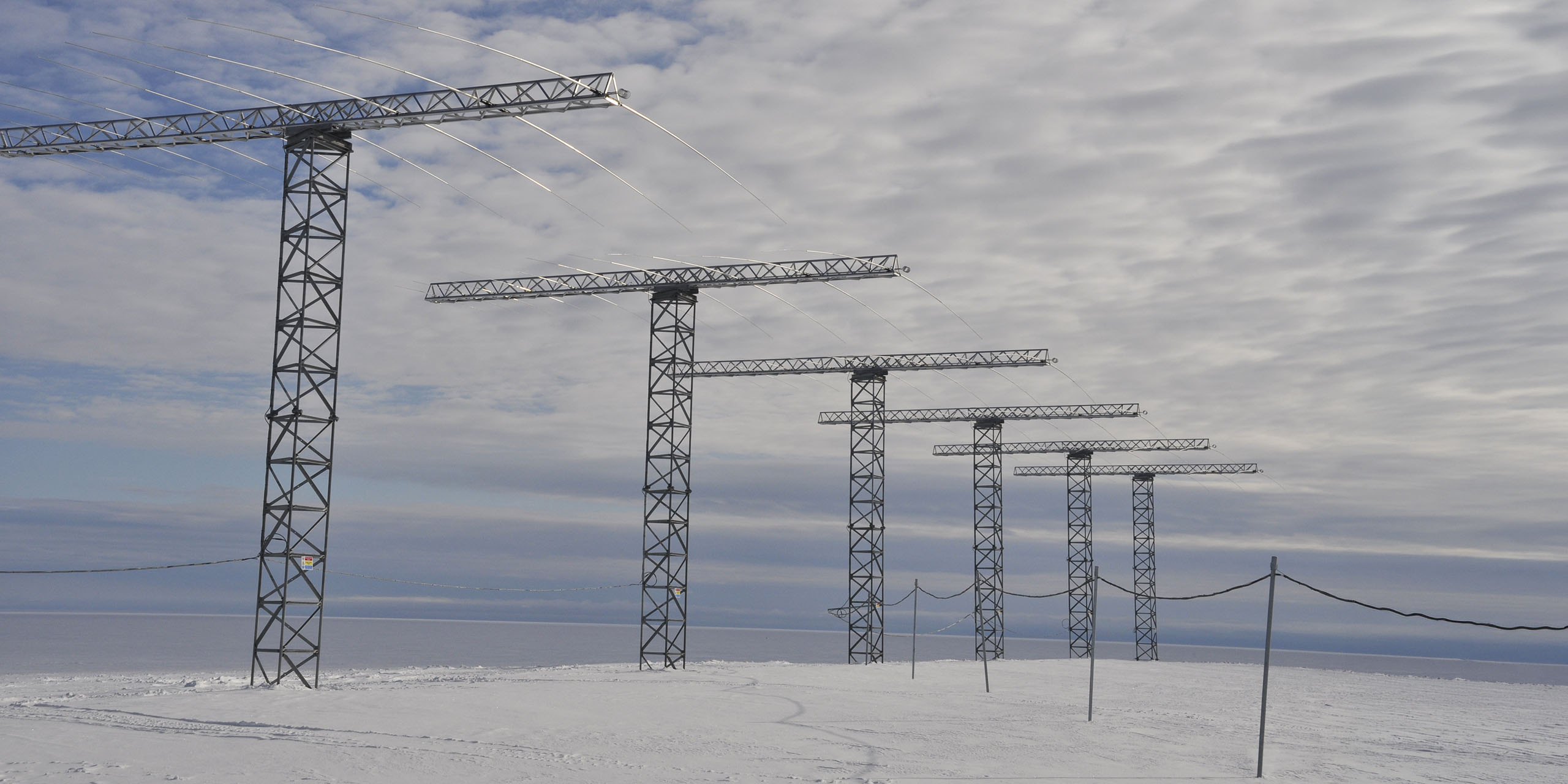
Salinity profiles of snow on sea ice in the Weddell Sea (Antarctica) during austral winter 2013
GB/NERC/BAS/PDC/00945
Abstract:
Small particles (known as aerosol) in the atmosphere play several critical roles. They affect the transmission of sunlight to the underlying surface; they affect the formation of clouds, and they host and enhance important chemical reactions. When they are deposited on ice they leave a record of past conditions that can be accessed by drilling ice cores. The most significant aerosol component over marine areas is sea salt aerosol. Over most of the world's oceans this is created by bubble bursting in sea spray. However there is strong evidence that another source of sea salt aerosol is important in the polar regions, and that this ultimately derives from the surface of sea ice. The existence of this source forms the basis for a proposed method using ice core data for determining changes in sea ice extent over long time periods. Additionally sea salt aerosol, along with salty sea ice surfaces, is the host for the production of halogen compounds which seem to play a key role in the oxidation chemistry of the polar regions. It is therefore important to understand the sources of polar sea salt aerosol and therefore to be able to predict how they may vary with, and feedback to, climate.
It was recently proposed that the main source of this polar sea salt aerosol was the sublimation of salty blowing snow. The idea is that snow on sea ice has a significant salinity. When this salty snow is mobilised into blowing snow, sublimation from the (top of) the blowing snow layer will allow the formation of sea salt aerosol above the blowing snow layer, that can remain airborne after the blowing snow has ceased. First calculations suggested that this would provide a strong source of aerosol (greater than that from open ocean processes over an equivalent area). It was proposed that this would have a strong influence on polar halogen chemistry and a noticeable influence on halogens at lower latitudes. However, this was based on estimates of the relevant parameters as there were no data about aerosol production from this source, and almost no data about blowing snow over sea ice in general.
Participation in a rare sea ice cruise onboard the German ice breaker Polarstern operated by Alfred-Wegener-Institut (AWI) provided the opportunity to access the sea ice covered Weddell Sea during Austral winter 2013. Snow on sea ice was sampled at various locations, and the snow salinity was subsequently measured in the ship's laboratory.
Citation:
Frey, M. (2017). Salinity profiles of snow on sea ice in the Weddell Sea (Antarctica) during austral winter 2013 (Version None) [Data set]. Polar Data Centre; British Antarctic Survey, Natural Environment Research Council; Cambridge, CB3 0ET, UK.. https://doi.org/10.5285/c0261633-fd14-4d45-a58d-72998816c4cd
Access Data
GET DATA:
License
| Access: | This dataset is made available under the Open Government Licence 3.0 (http://www.nationalarchives.gov.uk/doc/open-government-licence/version/3/) |
|---|---|
| Use: | This dataset is made available under the Open Government Licence 3.0 (http://www.nationalarchives.gov.uk/doc/open-government-licence/version/3/) |
Basic Information
| Creation Date: | 2017-07-05 |
|---|---|
| Dataset Progress: | Complete |
| Dataset Language: | English |
| ISO Topic Categories: |
|
| Parameters: |
|
Additional Information
| Ownership: | Natural Environment Research Council | |
|---|---|---|
| Project: |
|
|
RELATED DATA SET METADATA:
VIEW PROJECT HOME PAGE:
Extent
| Temporal Coverage: | |
|---|---|
| Start Date | 2013-06-21 |
| End Date | 2013-08-04 |
| Spatial Coverage: | |
| Latitude | |
| Southernmost | -68.06 |
| Northernmost | -63.41 |
| Longitude | |
| Westernmost | -51.24 |
| Easternmost | .1 |
| Altitude | |
| Min Altitude | N/A |
| Max Altitude | N/A |
| Depth | |
| Min Depth | N/A |
| Max Depth | N/A |
| Location: | |
| Location | Antarctica |
| Detailed Location | Weddell Sea |
Instrumentation
| Data Collection: | Surface snow on sea ice was sampled from top to bottom at approximately 2 cm vertical resolution. The bottom sample classified as ice is the top layer of the sea ice. Bulk salinities of melted snow samples were determined with a conductivity meter (Hach SensIon5, cell constant 0.437 1/cm) within 3 days of sample collection. The Hach SensIon5 ranges (resolution) are 0-199.9 (0.1) microSiemens; 200-19,999 (10) microSiemens; 2-19.99 (0.01) mS; 20-199.9 (0.1) mS. The Hach SensIon5 has automatic non-linear temperature compensation based on NaCl solution and reference temperature T=25 degC. The Hach SensIon5 was calibrated with a standard salt solution (REAGECON Prod. No. CSKC12880 Lot No. CS1288012K1) of 12.880 mS/cm at 25.1 degC, certified & traceable to N.I.S.T. |
|---|